The content and opinions found on this blog are mine alone, and do not reflect any position of the United States Government or the Peace Corps.

April 25, 2011

4th of Jul-island

A lot of people have this misconception that Peace Corps is some huge, selfless sacrifice, a sacrifice made with the goal of helping others, but still a sacrifice. On paper it certainly sounds this way: you've got to pack up your life, say goodbye to everyone you know, move halfway around the world, complete an excrutiating training program, settle by yourself in the middle of nowhere with a bunch of strangers who don't speak your language, and work on development projects for two years. On top of that, you must give up many basic creature comforts and do it all for less than minimum wage. Because of this, some refer to the experience as "self-inflicted masochism."

But the reality is that this can be a pretty kickass lifestyle. I teach seven 80-minute classes per week. If you include the time I spend grading assignments and planning lessons, that's maybe a 25-hour work week. There's no boss breathing down my neck and virtually no chance of losing my job. I receive one of the best healthcare packages on the planet, courtesy of Uncle Sam. Did I mention 24 paid vacation days a year? Sure, I'm paid a paltry $300 monthly living allowance. But when your rent is free, electricity is $5 a month, and $3 easily buys a day's worth of food, that $300 goes quite a long way. Especially when you consider the following indulgence: celebrating the 4th of July on a Kenyan billionaire's private tropical island in Lake Victoria, food and homemade banana rum included, for 20 bucks a night.

Banda Island is located 40 kilometers south of Entebbe, which served as the country's administrative seat during British colonial rule ("Entebbe" means "chair" in Luganda, an apt name selection by the Brits), and currently is home to Uganda's only international airport. After setting my midterm exams last July, I headed to the port of Kasenyi to take the boat down to Banda with a few other PCVs.

It turns out that there are no docks at Kasenyi, nor are there ferries. Instead, small, hand-crafted wooden boats perch about 10 meters offshore, awaiting passengers travelling to the Ssese Islands. The only apparent reason why the boats are parked like this is to place a short stretch of waist-deep water between dry land and the boats. This creates a wholly unnecessary, but lucrative, job for the local men: hoisting Ssese-bound travellers onto their shoulders, and carrying them out to the boats.
With our backpacks filled with cameras and iPods and dry clothing, we had no choice but to pay the men to carry us. One by one, we were loaded onto our boat (poorly, I'll add, since some people ended up getting their legs wet, defeating the purpose of being carried), and subsequently asked for ridiculous sums of money. "20,000 shillings!" one man demanded from my friend, Nathalie. "5000!" my carrier shouted at me. Now, I'd estimate that 1000 shillings has the same purchasing power in Uganda as perhaps $3 spent in America, even though it's worth only about 42 cents at the current exchange rate. So essentially, Nathalie and I were being charged $60 and $15, respectively, for a sloppily-executed shoulder ride! I handed my carrier two 500-shilling coins and laughed in his face. That was all he was going to get out of me.

The boat pulled away from land and we began our journey south of the equator. Given the situation, it seemed an appopriate time to listen to "I'm on a Boat" by the Lonely Island. An iPod and portable speakers were pulled out, and soon we were all singing about "busting five knots" and fucking mermaids. There were a few Ugandan passengers with us, but we figured that the 4th of July justified us being ugly Americans, just this one time.

Five hours later, it seemed almost comical to think that being on a boat would ever be something to brag or sing about. Four foot waves had been pounding us from the front (sorry, "the bow") nearly the entire way and it didn't look like we were getting any closer to the island. Water bottles had been urinated in, and then accidentally spilled because of the boat's rocking. A penis (Boy Devon's) had been spotted by mistake while it was filling one of these bottles. Rather than exciting its female viewer (Girl Devon), it caused her to vomit multiple times over the side of the boat. One girl in our group, who was suffering from an untimely case of giardia, crapped her panties. A few compassionate Volunteers assisted her in the clean-up while everyone else turned away, trying to ignore the unmistakable aroma of poo beginning to taint the air. The sun had gone down, and damp with schistosomiasis-infested lakewater, we started to seriously question whether we would reach dry land at all.
Thankfully, it was only another 40 minutes or so before the boat pulled up to a bank, dumped us on land, and sped off before we got a chance to ask why Banda Island Resort looked like a deserted grassy knoll. Where were the beach cottages? The volleyball net? And most importantly, where was the banana rum?

We had been scammed. The boat was supposed to take us directly to the resort, but instead dropped on the wrong side of the island so that another boat driver, conveniently waiting for us at the drop point, could charge us 20,000 shillings for a ride to the other side. Once again, we grudgingly handed over our money for an unnecessary ride.

Finally, finally, FINALLY we reached the resort. We were greeted by a palm frond beach fire, a pack of barking dogs, and two Israeli girls. The girls, fresh out of compulsory military service, had been invited to take care of the resort for a few weeks, after meeting its wealthy owner on their post-service travels in East Africa. They helped us unload our food and backpacks, which had done an excellent job of soaking up the vile liquids that had collected in the bottom of the boat, onto the beach, then showed us up to the island's "castle" for dinner.

Dinner in the "castle"
The rest of our Independence Day weekend, thank God, went a lot smoother than the boat ride. We packed in many hours of hardcore unwinding: reading in the hammocks strung from some lakeside trees out back of the castle, playing cards on the beach, swimming in the water (while praying we wouldn't contract schisto) and hiking up the island's main hill for a panoramic view of the lake and surrounding islands. The place was gorgeous and chill, and we had it all to ourselves, except for the Israeli caretakers, the cook staff, and an extremely stoned South African Member of Parliament (out of courtesy, I won't post his name) with travel buddy in tow.

Foreground: A Ugandan mancala game called omweso (way better and more complex than regular mancala). Background: someone chilling out in a hammock
Get out of my picture, bitch!
Bald eagle! Well, a wannabe, but who cares? Go America!
Back home in Ohio, Dave "Smiles" from our group – so called to differentiate him from the three other Daves we trained with, because he is perpetually smiling – had this 4th of July tradition he called Jortstock: he and his friends would cut up jeans into short shorts (jorts), which they would celebrate the holiday in all day long. Smiles, Boy Devon, and I decided to carry on the tradition. In light of it being America's birthday, I chose to make my jorts out of a pair of Obama Jeanswear jeans, a cheap Chinese brand with OBAMA stitched across the back pockets and legs. They were hideous, of course, but an entirely necessary component of our Jortstock 2010 take on the Iwo Jima war memorial:

It's not gay if you're doing it for America.
At the end of the weekend, we all took the boat back to the mainland. The trip only took two hours this time, with placid water and sunny skies the whole way. Of course, dozens of people carriers were waiting for us at Kasenyi. As we neared the shore, we could see them jostling each other, each determined to grab one of us out of the boat and take our money. Everyone on board was tense, waiting for the onslaught. It was like D-Day. When we reached the shallows, the carriers dashed towards us and started pushing the boat back. They wanted to keep us in deeper water so that we had no choice but to be carried. Our driver, though, knew the carriers' sheisty ways. He gunned the outboard motor as hard as he could, blasting them out of the way and landing us safely on shore. The Americans won the battle. A perfect end to a perfect 4th of July weekend.

Getting spanked with an American flag flip flop while wearing Obama jorts. Could I get more patriotic?

Charlene sings into her "mic" on the ride back

April 20, 2011

Killing to Live

Here, meat doesn't come wrapped in plastic on a styrofoam tray, with a barcode sticker slapped on the outside. That's the stuff of the First World. Here in Africa, if want to cook meat, you're going to have to kill the animal it came from yourself. That or come face to face with its hacked-up innards at a village butcher. Either way, you are confronted, point blank, with the consequence of your decision to be carnivorous: something is going to die so that you can live.

That being said, I still eat meat in Uganda because meat is just too tasty to ever give up. But now I have a fuller appreciation for what has to happen to turn a living, breathing animal into food for people. Blood and guts are an inevitable part of that process. In my opinion, if you can't handle the gore of the slaughter, you don't deserve to eat meat.

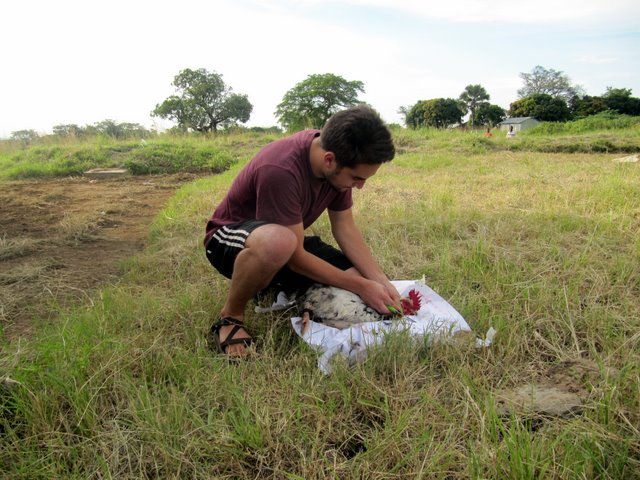
I had my first experience with slaughtering an animal this past Thanksgiving. I was celebrating the holiday at my friend Jake's house in northern Uganda, along with my other PCV friends Bernadette and Siong, and PCRV (Peace Corps Response Volunteer—a former Volunteer who opts to do a short term deployment in an area of critical need and sometimes higher risk) Bill. Though Thanksgiving is of course a day for eating turkey, turkeys can be difficult to find in Uganda, so we decided to buy two live cocks instead.

Eager to earn the right to eat chicken for the rest of my life, I volunteered to slaughter the first cock. Afterwards, I described the experience to my oldest friend Daniel, who lives in New York, over instant messenger. Here's an excerpt from the chat log:

(11:46:42 PM) Me: but the chicken....
(11:46:55 PM) Me: it was kind of intense
Bernadette and I, dressed to kill.

(11:47:21 PM) Me: my heart was pounding as i walked with it to the spot where i was going to kill it
(11:47:36 PM) Me: it felt like some really important initiation rite
(11:48:29 PM) Me: my friend showed me how to pin it to the ground, then plucked some feathers from its neck to clear a spot for the knife
(11:49:21 PM) Me: and then told me that it's simple, but once you start you absolutely cannot stop cutting until the head's off
(11:50:21 PM) Me: so i pinned the wings back with knee, grabbed the head and stretched out the neck
(11:50:31 PM) Me: and stated slicing


(11:51:52 PM) Me: severed the windpipe, some blood shot out, the chicken was struggling frantically, then i hit the neckbone and got stuck for a few seconds
(11:52:49 PM) Me: it was a bit fucked up. i felt bad cause obviously the spinal cord was still intact but the entire front of its neck was cut all the way through
(11:53:18 PM) Me: so i sawed and sawed as hard as i can until i cracked through the bone and the head was off
(11:54:13 PM) Me: and chickens really can run around with their head cut off. i had to hold it to the ground for about five minutes before the heart and powerful muscle spasms stopped. it was kicking that whole time
(sic)
(11:56:13 PM) Me: my other friend bernadette also killed another chicken after me, but she was scared so she closed her eyes and made the cut too low
(11:56:33 PM) Me: hers was smaller so the neck was thinner and the head came off almost instantly
(sic)
(11:57:58 PM) Me: but the low cut made the esophagus come out and flop around wildly like one of those children's water toys that you hook up to an outdoor spigot. it flailed around and shot blood all over bernadette
(12:00:59 AM) Me: dude but the most disgusting part wasnt the actual kill. it was making a circular incision around the anus and pulling all of the innards out from the back
(12:01:39 AM) Me: … pulling out a chicken anus is fucking nasty
(12:03:11 AM) Me: me and jake (another friend whose house we were at) both accidentally cut open the stomach and all this half digested food spilled inside the chickens, which smelled HORRIBLE
(12:04:00 AM) Me: … all in all its incredibly gruesome, but in the end it looked like a whole chicken you'd buy in a store
Cock pluckin' motha ukkas.
(12:04:51 AM) Me: … we made "beer can chicken": drink half a can of beer, stick the can up the chicken's ass, and bake it. the beer evaporates into steam and cooks the chicken from the inside

With our masterful culinary skills, a bucket oven (a small pot resting on some stones within a larger, covered pot, placed over a fire – the standard Peace Corps substitute for an actual oven), and some Lowry's seasoning salt, we managed to prepare a decent main course. Siong's Chinese stir-fry made the meal a complete, albeit unconventional, Thanksgiving dinner.

Since killing my first chicken, I've killed just one other, as well as watch another Volunteer slaughter a goat in Fort Portal this past weekend. (We marinated the meat in soy sauce and meat tenderizer, skewered it, and grilled it. The grill itself was made from an empty oil barrel halved lengthwise and mounted on 4 metal legs, with some scrap mesh fencing placed over the hot coals.) I'd upload the video of the kill, but it's hard to upload a file of that size on my slow Internet connection. Besides, it's incredibly disgusting. For now, I'll leave you with some pictures of the delicious aftermath.

Slaughtering an animal for food is powerful experience. I encourage every meat eater to try it at least once. It'll help you appreciate the cost of your survival.

Before
After
Brian cuts the meat over some banana leaves
Kristin (PCV Paraguay, left) and Elizabeth fan the flames
Several people had birthdays, so we finished the meal with homemade chocolate and carrot cake.
Renee, Alexi, Boy Devon, and Girl Devon blow out the candles

March 30, 2011

Back to School / A Rant About Fear

Registration of new students.

Having grown up in the US, where the school year begins in September, I tend to associate going back to school with the end of summer and its promises of cooler weather, falling leaves, pumpkin pie, and all that autumnal stuff. Here in Uganda, though, the school year begins in early February, at the height of a long dry season. Instead of falling leaves, there's falling ash from farmers burning their dead, dry fields in preparation for the coming wet season. The sun shines bright and hot every day; it goes for weeks without raining. Overcrowded taxis rocket down the dirt highway I live on, sending up opaque plumes of red dust that find their way into every corner of every house. The dust is so thick you can practically chew the air. In short, it's a far cry from pumpkin pie.

Still, the back-to-school season here is a time for starting fresh, just like in the States. After a long "winter" break that included some HIV/AIDS education work with the US Embassy, an awesome visit from my family, a safari, hiking up a 12,000-foot volcano into three countries, and a rollicking trip through Egypt with two of my best friends just days before Hosni Mubarak was overthrown (I'm a little behind in posting, can't you tell?), I returned to teaching last month. It was nice starting school from the beginning of the school year. When I swore into service last April and headed out to the field, I began teaching in the second academic term, with very little idea of what I was doing, how to manage a class, or how a Ugandan school functions. Now, with two full terms of teaching and eleven months of service under my belt, I can confidently say that I have some idea of what I'm doing. Well, some idea of what I'm doing wrong, anyway, and possible ideas for how to do things right.

I took pictures of the whole Senior 2 class holding name cards to help me learn their names. The kids whose names I managed to learn last year tended to pass my class.

The first thing I made sure to do differently this year was put together a syllabus for each class I was teaching, and give a printed copy to every kid. Uganda is not very literate or text-oriented society ("reading culture is not there," as the locals say), so this kind of direct, written communication, especially to students in a government school, is extremely uncommon. In my syllabi, I outline my class rules, grading scheme, topics to be covered, office hours, etc. This ensures that my students know what to expect from me and what I expect of them. In doing this, my goals are to establish clear, two-way communication between myself and my students, to replace ambiguity with black-and-white, and to eradicate the traditional Ugandan teacher-student relationship from my classroom.

The traditional relationship is built around the idea that the student who fears his teacher learns best, because he is motivated to study hard in order to avoid punishment. Almost every Ugandan teacher I've met is dead-set in this mentality; the idea that our students are failing tests because they didn't fear the teacher enough to study hard ("they are not serious [about studying] because they are not fearing [us]") comes up at every faculty meeting. Some teachers will cane students for failing tests, in order to inspire fear, which they believe will encourage students to "pull up" their grades. I have literally shaken with rage when I've seen this happen. Imagine 30 teenaged girls in a line, shrieking like wounded animals as they are whipped one-by-one with thick sticks, while a few other teachers off to the side watch and laugh. It's fucking sick. Corporal punishment is never appropriate in my book (using violence to solve nonviolent problems – is that something we want to impart to future generations?), but especially not in this case. Though it's true that students in my school should be studying a lot harder than they are, that alone is not the reason for their poor performance. Large classes, no textbooks, the failure of teachers to show up for class (a huge problem here), and lecturing unclearly or ineffectively when they do . . . these also factor into bad grades. By beating kids for bad grades, teachers are blaming students for their own failings as educators. Fucked up, no?

The larger issue here, I think, is that this society confuses fear with respect. "Fearing God" and "fearing your parents" are commonly cited as values that should be instilled in children by schools and other institutions. Disgustingly enough, USAID funds the development of many Ugandan-made PIASCY (President's Initiative on AIDS Strategy for Communication to the Youth) materials that promote these same values. I show the federal government how I feel about this misuse of my taxes by wiping my ass with PIASCY pamphlets whenever I run out of toilet paper. While fear can in some cases inspire respect, fear and respect are not the same. Fear creates hierarchy when one person, to protect themselves from harm, submits to the will of another person who would otherwise harm them. Fear drives the submissive person to respect the other's authority. I believe that Ugandan society is really after this respect of authority, not the fear itself. Students and children should be doing what their teachers and parents tell them to do; they should be heeding to the requests of the authority figures in their lives. Inspiring fear is just one way of getting this to happen, and an extremely flawed one at that. In schools, the use of fear by teachers has some crippling side effects: students become too scared to ask questions in class, attempt work that they might make a mistake on (so they literally cannot learn from their mistakes!), or correct the teacher when he or she makes a mistake. Once again, we are smacked in the face by the twisted irony of the traditional Ugandan teacher-student relationship: the teacher uses fear to force the student to show respect and learn better, but this makes the student too scared to learn. The student fails the class. The teacher has thus failed at his job, but blames the student entirely for this outcome. The teacher then uses fear to force the student to show respect and learn better, and the cycle repeats.

Let me end this rant before my righteous foaming at the mouth spills over and damages the keyboard. To be brief, this year I am trying new methods to earn the respect of my students and help them master course material. These methods use positive reinforcement (rewards, pleasant interactions, etc.) rather than fear to generate respect. My classes are still large (there are 158 kids in my new Senior 1 class) and sometimes rowdy, but learning is definitely happening, and my students have a noticebly more positive relationship with me than with most of the other teachers, who scare and heckle them constantly. Maybe I can help the other teachers see that there multiple paths to respect; I'd like to think I can. We'll see.

Stay tuned for my next post. I'll tell you all about my secondary projects, with at least 40% less rant. Promise.

March 25, 2011

Rocket Stoves

The three stone fire is an essential component of Ugandan cooking, and is as ingrained in local culture as the languages Ugandans speak. The set-up is simple: a wood fire, three stones placed around the fire, and a pot resting on top of the stones, filled with simmering meat stew, rice, or matooke bananas. This (or a similar variation) is how the majority of Ugandans prepare their food. The formula hasn't changed much since humanity first learned to harness the power of flame.

Unfortunately, this simple way of cooking has some serious drawbacks. First of all, the smoke given off by a three stone fire is a major cause of respiratory illness. Many Ugandan homes have a separate hut for cooking so that the smoke doesn't enter the house itself, but that doesn't do much for the cook, who must tend to the food and the fire for hours on end (Uganda has America beat on the slow food movement by a good 12 centuries or so). Secondly, the combustion reactions that happen in a wood fire release tremendous amounts of carbon dioxide, which contributes to global warming. Finally, a three stone fire wastes wood: the large gaps between the stones expose the burning wood to lots of air, allowing heat to escape without cooking the food, and causing the wood to burn up quickly. Wasting wood here is no laughing matter; Uganda is currently suffering from severe deforestation, to the extent that it may need to begin importing wood from neighboring Kenya, a costly move. Many Ugandans have planted eucalyptus trees, which reach maturity in just four years, to combat deforestation, but this is not without its own pitfalls. Eucalyptus is not native to Africa; it was introduced to the continent from Australia in the late 18th century on one of Captain Cook's round-the-world voyages. In African soil, the tree is a notorious water hog, drainining so much moisture from the ground so that nothing but short grass can grow nearby. Not good in a place where upwards of 80% of the population are farmers.

Enter the "rocket stove". The rocket stove is a marvelous device made of locally available materials, including bricks, clay, mud, sawdust, and rice husks. It seals in the heat of a wood fire, directing most of the energy towards the cooking pot with minimal losses. It creates a nearly smokeless fire. It uses 60% less wood than a three stone fire. And a twin burner industrial size model (ideal for schools) costs less than $200 to make.

PCV Heather shows us how it's done.

The rocket stove is scientifically designed to make the world more awesome.

This past weekend I made the six-hour trek up to Gulu, a large town in northern Uganda, to help Drew and Bina, two married Volunteers, build some rocket stoves at their site. The event was the first of a series that I'll be attending this year as part of Peace Corps' 50th anniversary celebration. Upcoming events include rehabilitating a primary school south of Kampala next weekend, and painting informational HIV/AIDS murals at my friend Ashley's site in Rakai District, near the Tanzanian border.
I liked Gulu a lot. It's a much larger and nicer town than Hoima, which is probably attributable to the development work done by the gazillions of NGOs that call it home. Northern Uganda receives a lot of foreign aid because of the rebel warfare that ravaged its countryside for twenty years, forcing millions of people into internally displaced persons (IDP) camps and annihilating any kind of economic activity. The NGOs that flock to set up shop in Gulu bring in foreign workers (read: young, idealistic upper middle-class white folks), which encourages locals, and some of the foreigners, to create businesses that cater to them. Needless to say, I spent a lot of the long weekend indulging in all things mzungu: chatting in trendy coffee shops, eating hamburgers, Indian, and Ethiopian food, and floating on my back in the pool of an upscale hotel.

But somewhere between eating good food and partying with NGO workers, we managed to get two rocket stoves built for Drew and Bina's host organization, the Gulu Youth Development Association (GYDA), which provides classes and vocational training to youth unable to go to secondary school for behavioral or other reasons. The turnout was fantastic. We had way more than enough help, which was great because it meant that the PCVs could take a step back and let the locals learn how to make the stoves themselves.

PCV Jill oversees the bricklaying operation.

Still, we enjoyed getting our hands and feet dirty:

Mixing termite mound soil (part dirt, part clay) with water, sawdust, and rice husks to create mud. Kind of like stomping grapes! When the mud mixture is exposed to fire, the sawdust and rice husks burn up, leaving behind tiny holes that trap heat, turning the stove into a great insulator. Your coffee mug works the same way.

I had to get back to site early in order to teach, so I left before the stoves were finished, but all in all it was a fun, productive weekend.

And now, some cute Acholi kids:


February 18, 2011

Teabagging

American tea (Celestial Seasonings brand):
Ugandan tea:
Teabag marketing: a development level indicator? Discuss.

February 13, 2011

One Year in Africa

This past Friday marked one year since I first set foot in Uganda, one year of being in the Peace Corps. I'm proud of reaching this milestone, and of the 27 phenomenal PCVs I trained with who made it this far with me. It's been a crazy year, full of high highs, low lows, discovery, adaptation, and adventure. I could not ask for a richer or grittier experience.

The "toughest job you'll ever love" cliché that Peace Corps Washington delights in stuffing down our throats has of course turned out to be an accurate description of what being a Volunteer is like (hey, clichés are clichés for a reason). I've made some great friends and had some outstanding times, but cakewalk, this job is not. I've had to adapt to a simpler lifestyle that does not include running water, modern appliances, convenient transportation, reliable electricity, or access to a variety of foods, music, or consumer goods. I've accepted the fact that I will often be hot and sweaty and that there's no A/C or iced drink to cool me down. I've gotten exotic illnesses like dysentery and malaria, and will probably be able to check a few more off the Oregon Trail list before I get out of here. I've dealt with isolation and loneliness, and suffered debilitating psychological side effects from a malaria prophylaxis (thankfully I switched to a different malaria medicine in August, which fixed things almost immediately). I've experienced firsthand what rampant corruption, disfunctional democracy, hateful tribalism, and utterly inept educational systems can do to a society. I've banged my head against the wall in anger and frustration with the shitty, illogical ways Ugandans do things. And I've struggled to become a competent teacher in spite of having unmanageably large classes, students who barely speak English, no textbooks, and not a whole lot of teacher training myself. But far from defeating me, these challenges have made me stronger, more versatile, and more determined to succeed in initiating social progress.

Sometimes the hardening of my character has come at the cost of human empathy. Abject poverty is so omnipresent here that you become desensitized to it after a while. When a barefoot Karamojong child comes up to me on the street in her tattered clothing, asking for money, I feel nothing. My thought process supresses the emotional and makes a beeline for the rational: Why should I help this particular kid when there are thousands more just like her? That's probably her mom sitting there across the street, whoring her out for muzungu pity-money. Giving her some coins is not sustainable. Handouts generate foreign aid dependency.

For the most part, though, the changes I've noticed in myself have been overwhelmingly positive. I feel more confident and independent. I am more self-motivated, inclined to work on projects or refine my teaching skills, not because somebody is telling me to, but because I want to. I am more pragmatic because I have a better understanding of my limitations and factors that are within my control. And I am more patriotic because of the perspectives I've gained from serving here. America has its fair share of problems, for sure, but at least it has a working multiparty democracy, rule of law, accountability, truly free and quality public education, sanitary and accessible medical care, an innovative spirit, cutting-edge technology, effective social welfare programs, advanced industries, developed markets, and the strength that comes from a population diverse in ethnic background, aspirations, and thought. [Fuck yeah!]

After being in Africa for a year, I miss America. I really really do. But that's a good thing because it means I appreciate my home, and in ways I wouldn't have appreciated it had I not come here. Perhaps that's what I'm supposed to take away from this whole experience. And perhaps "the toughest job you'll ever love" is really about channelling that appreciation into positive conversations about the U.S. with locals, and into projects that sprout American ideas in host country soil.

Year two, bring it on.

October 14, 2010

Minutiae

The following is an unapologetically disjointed collection of observations, opinions, images, and accounts of recent events. Enjoy.

1. Justification for 12x optical zoom in a consumer grade camera: the President of Uganda decides to sit a few rows up from you at a football match. By the way, he wears that goofy hat everywhere. Rumor has it that it's bulletproof.


2. I finally picked up a can of Bop insecticide and obliterated the out-of-control insect population in my house. No longer will the flavor of my morning coffee contain hints of cockroach!


3. On Saturday, my friend Meg came to visit me in Kiziranfumbi. Meg is an American who works for a Hoima-based NGO called Innovations for Poverty Action, and is the only other white person I know in the area. Meg and I decided to go throw a frisbee around on the large field across the street from my house. Immediately, we were joined by hordes of village kids who were intrigued by "the plastic plate". We tossed the disc with them for a bit, until a mix of primary and secondary school students showed up with some drums, something I call "butt-shaking half skirts" (no clue what they're actually called, but I doubt the local name could compete with mine for descriptiveness), and these shin guard-like things with bead-filled wooden bells attached to them (your dancing becomes percussion music with these strapped to your legs). We put the frisbee down and went over to watch the performance. The kids sang, drummed, and danced, and Meg and I were captivated. They were fantastic! And the songs and rhythms were really catchy; way better than the crappy reggaeton on the radio. I started listening carefully to the words in Runyoro. One song was about being nice to sick people and the message of the next one could be summarized as, "Women and girls, AIDS is bad. AIDS kills. You must wait [to have sex]". It turned out that the singers and dancers were part of a troupe that travels around the area, promoting sexual abstinence as a way to reduce the spread of HIV/AIDS. I imagine their campaign is pretty effective, given the repetitive, yet catchy-sounding lyrics.


4. Ugandans do the "come here" hand gesture upside down. Instead of motioning towards himself with the index finger, palm facing up, a Ugandan turns his palm down and repeatedly draws all four fingers towards himself. Weird! I'm still trying to kick the habit of doing it the American way.

5. Clowns are terrifying.


6. On the equator, the moon's crescent appears under the dark part of the moon, instead of to the side.


7. I wish my headmaster would stop dismissing students from school the day before exams for not paying their school fees. I walked into my S1 math class last Wednesday to hold an hour-long review session and like 80% of the kids were missing. Eighty percent! I will not be the least bit surprised if that many fail the midterm (though my fingers are crossed for marginally better results).

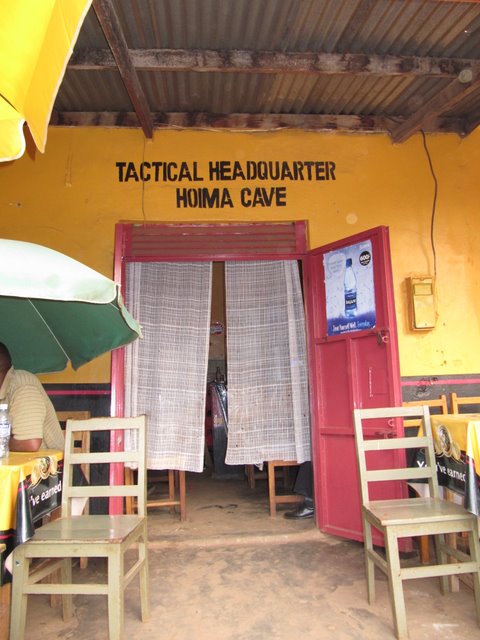
8. Some bars have better names than others. However, I defy you to come up with a better one than "Tactical Headquarter Hoima Cave".


9. Check out this sweet mud hut up the road from my house:

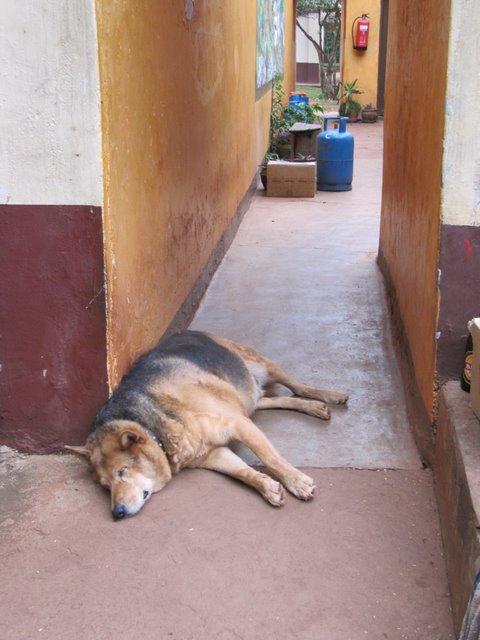
10. Dogs here seem to be nocturnal. They spend all day passed out in the heat, then wake up shortly after the last kerosene lantern flickers out to howl the night away. Look at this demi-bear snoozing at the Red Chili Hideaway (a hostel I often stay at in Kampala):


11. Speaking of Red Chili, they also have a rather ginormous pig:


12. Here in Africa, there are furrier options for travel than the dogmobile in Dumb and Dumber:


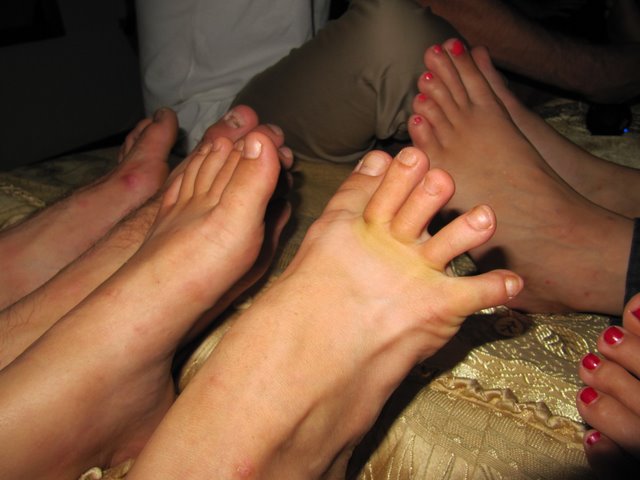
13. Last but not least, Arwen has freaky deaky monkey feet.